
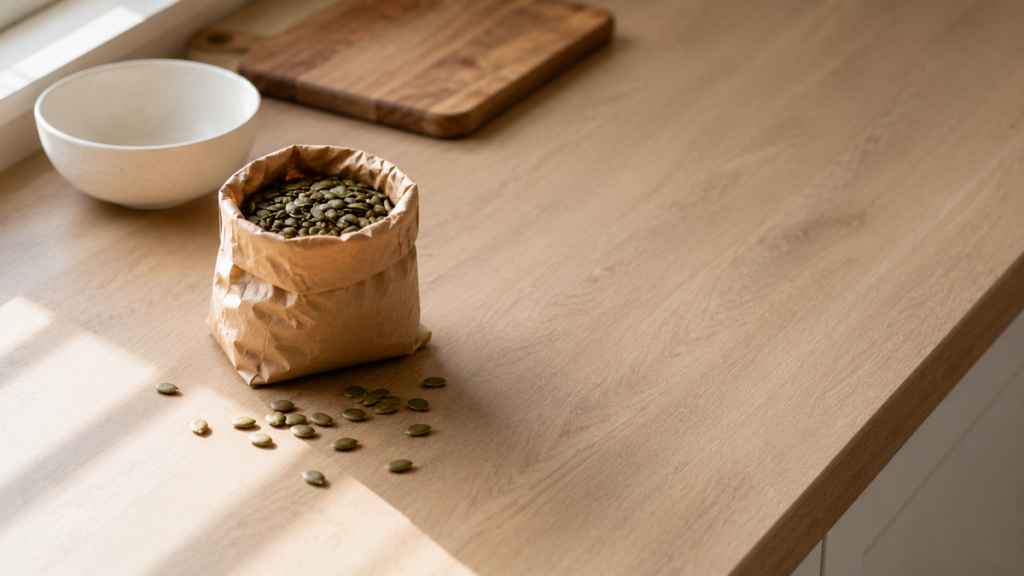
There is a version of this decision that happens in a shop, and it is not a difficult one to picture. A bag of pumpkin seeds on one side, a bottle of magnesium capsules on the other. The capsules say 250 mg and cost less than the seeds. The seeds say nothing at all about magnesium, because seeds don’t come with a label making claims.
The intuition almost everyone brings to that moment is that the capsule is the efficient route. It’s measured, it’s concentrated, it’s designed for the purpose. Food is the slow, imprecise version of the same thing.
I went looking for whether that’s true, and found something I don’t often find in this work: somebody had actually run the comparison. Not a mechanism argument, not a plausible inference — a randomised crossover trial that put food and a supplement side by side and measured what happened.
Educational, not medical advice. Magnesium is cleared by the kidneys; anyone with impaired kidney function should not supplement without a clinician involved.
Start with the arithmetic, because it settles more than you’d expect
The number worth anchoring to is the dose that produced a measurable result in a human trial. In the 2025 bisglycinate sleep study we covered in our magnesium comparison, that was 250 mg of elemental magnesium daily.
So: what is 250 mg in food?
Roughly 45 grams of pumpkin seeds. Pumpkin seeds run about 550 mg per 100 g, making them the most concentrated everyday source by a wide margin. A single ounce — 28 g — delivers somewhere between 150 and 175 mg depending on which source you consult.
Or, if you’d rather not eat seeds by the handful, an ordinary day gets you there without trying:
- Pumpkin seeds on your breakfast, one ounce: ~150 mg
- A cup of cooked spinach at lunch: 156 mg
- Half a cup of black beans at dinner: 60 mg
That’s 366 mg before you count anything else — bread, chocolate, a banana, the almonds you ate at four in the afternoon. Comfortably past both the trial dose and the recommended daily intake of 310–420 mg depending on your sex and where you live.
I want to flag why this matters, and it’s not obvious. Most of the compounds I write about cannot be reached through diet, and I say so. The L-theanine dose that shows cognitive effects requires something like fifteen cups of green tea. The melatonin in tart cherry juice is thousands of times below a functional dose. In those cases the food argument is wishful thinking and the honest answer is that if you want the studied effect, you need the isolate.
Magnesium isn’t like that. The arithmetic works. Which means the interesting question isn’t whether you can get it from food — you can — but whether the capsule does the job better.
The absorption twist
Here is where the intuition turns out to be backwards.
In 1991, researchers at a Texas medical centre gave eight healthy men a standard meal plus escalating doses of magnesium — zero, then progressively larger amounts up to a very high single load — and measured how much they actually absorbed.
Fractional absorption fell from 65% at the lowest intake to 11% at the highest.
The proposed mechanism is a saturable transport system that reaches a ceiling, plus a small fraction — around 7% — that gets absorbed regardless of dose. Load more magnesium into a single sitting and your intestine takes a progressively smaller share of it.
Sit with what that implies about format. A capsule delivers its entire dose in one swallow. Food, by its nature, arrives in smaller amounts spread across a day: seeds at breakfast, greens at lunch, beans at dinner. On the absorption curve, the second pattern sits in the efficient zone and the first doesn’t.
This is also, incidentally, why high-dose magnesium supplements cause loose stools. The unabsorbed fraction stays in the gut and pulls water in. The laxative effect isn’t a side effect of magnesium — it’s the direct signature of the dose exceeding what you can absorb.
There’s a second mechanism running in food’s favour, and it’s measured in humans rather than inferred. Fermentable fibre — the fructo-oligosaccharide kind — increases magnesium absorption by 10 to 25%. Where do you find fermentable fibre? In beans, seeds, whole grains and vegetables. The same foods carrying the magnesium also carry the thing that helps you absorb it.
Then someone ran the actual comparison
A team at the Institute of Food Science and Human Nutrition at Leibniz University Hannover — the same institute behind the bisglycinate sleep trial — designed a study to test food against supplement directly.
Twenty-two healthy men and women, randomised, controlled, crossover design with one-week washouts. Six test products, each providing exactly 100 mg of magnesium: four mineral waters with different mineral profiles, bread, and a magnesium supplement. They measured 24-hour urinary magnesium, the urinary magnesium-to-creatinine ratio, and serum magnesium area under the curve over ten hours.
No significant differences among any of the groups, on any measure.
Bread performed like the supplement. Mineral water performed like the supplement. The authors’ conclusion is worth quoting for its flatness: given equivalent magnesium availability from all test products. They noted that mineral water in particular constitutes a calorie-free magnesium source — which, for a mineral you’re trying to get more of, is a real advantage over seeds.
Now the caveats, because a single trial does not close a question. Twenty-two people. A single 100 mg dose, not a daily regimen. Surrogate endpoints — urinary and serum magnesium tell you the mineral was absorbed, not that anyone slept better. And nobody has compared food-based magnesium against a supplement on a clinical outcome like sleep, blood pressure or cognition. That trial does not exist.
What it does establish is narrower and still useful: at an equivalent dose, magnesium from ordinary food is as available to your body as magnesium from a capsule. The concentrated format buys you convenience, not efficiency.
What the food route genuinely costs
I don’t want to write the version of this article where food wins on every axis, because it doesn’t.
Calories. Forty-five grams of pumpkin seeds is about 260 kilocalories. Almonds are in the same territory. If you’re getting most of your magnesium from nuts and seeds, you’re adding a meaningful amount of energy to your day — which may be exactly what you want, or may not.
Phytate is real. The compound that stores phosphorus in seeds, nuts, legumes and whole grains binds minerals in your gut, and it reduces magnesium absorption dose-dependently — in one comparison, by up to 60% from wholemeal bread versus phytate-free white bread.
But read the same review’s next sentence, because it’s the part that gets left out: the lower fractional absorption from wholemeal is expected to be counterbalanced by the much higher magnesium concentration in wholemeal in the first place. Absorbing 40% of a large amount can beat absorbing 90% of a small one. The phytate objection is a real mechanism and usually a poor argument against whole foods.
Oxalate in greens, and something you can actually do about it. Spinach contains oxalate, which also binds minerals, and this is where the measured numbers matter. When researchers compared magnesium absorption from a diet containing raw spinach, boiled spinach, and no spinach, they got 80.2%, 88.4% and 88.9% respectively. Boiling removed about half the oxalate and brought absorption back nearly to baseline.
So yes, raw spinach absorbs slightly worse. Note the absolute figures though — eighty per cent from raw spinach is excellent absorption. The practical takeaway is small and free: cook the greens.
A number worth checking yourself
While researching this I came across a supplement retailer’s guide stating that real-world magnesium absorption is 35% from spinach, 25% from almonds and 15% from fish, and concluding that food alone is insufficient — that most adults need 100 to 300 mg of supplemental magnesium beyond their diet.
The measured figure for spinach, from the study above, is 80.2% raw and 88.4% cooked. That’s a discrepancy of roughly two to three times, and the retailer’s guide gives no primary source for its numbers.
I’m not going to speculate about how that happened. I’m pointing at it because it’s a good example of a habit worth developing: when a page tells you a nutrient is poorly absorbed from food and better absorbed from the product it sells, the absorption figure is the thing to look up. In this case the actual measurement is publicly available and points the other way.
The same page is also, to be fair, the sort of source that gets cited by people who aren’t selling anything — which is how a number with no origin ends up circulating as common knowledge. This is the same pattern as the dose arithmetic on tart cherry juice: a plausible-sounding figure that nobody traced back.
Who this actually matters for
The honest answer to “should I get magnesium from food or a pill” depends on something more specific than either option.
The bisglycinate sleep trial found its improvements were greatest in participants with lower baseline dietary magnesium intake. That’s the whole story in one clause. The intervention worked by correcting a shortfall. It follows that if your diet already delivers 400 mg, adding a supplement is unlikely to do much — and if it delivers 150 mg, the shortfall is the problem, and closing it with lunch works as well as closing it with a capsule.
So the useful question isn’t which format is better. It’s: how much are you actually getting? Add up an ordinary day using the numbers above. If you land near the recommended intake, you have your answer and it doesn’t involve buying anything. If you land at half of it, you have a specific gap and two equivalent ways to fill it.
One asymmetry does favour food, and it’s not about absorption. Dietary magnesium has no established upper limit and no associated adverse effects. Supplemental magnesium has a tolerable upper intake of 250 mg a day in European guidance — which happens to be exactly the dose the sleep trial used. Food gives you room that the isolate doesn’t.
What I’d do
Count first. One week of rough arithmetic on what you actually eat will tell you more than any article, including this one. The numbers you need are above and they’re not complicated: seeds and nuts are the concentrated sources, cooked greens and beans are the reliable ones, and everything else contributes a little.
If there’s a gap, the cheapest fix is a handful of pumpkin seeds, which will close a hundred and fifty milligrams of it on its own. Cook the spinach rather than eating it raw. If seeds and their calories don’t fit your day, magnesium-rich mineral water does the same job with none of them — and it performed identically to a supplement in the one trial that checked.
If you’d rather take a capsule, take a capsule. Nothing here says supplements don’t work; the trial evidence says they do, at 250 mg, in people who were short. Just don’t take one on the belief that food can’t do the job. On the only measurement anyone has made, bread did it just as well.
About this article
Written by Leah Elish. Covers diet, micronutrients, the gut-brain axis, and longevity eating patterns. Not a dietitian or clinician — traces nutritional claims back to the studies that supposedly support them.
Medical review: None. NeuriFuel does not currently have a licensed clinician on the editorial team, and this article has not been medically reviewed. We state this rather than implying an authority we do not have. See our About page for our full methodology.
Sources: Built from the direct food-versus-supplement crossover trial, human absorption studies including the dose-response work on fractional absorption, and food composition data. Commercial sources are identified as commercial in the text, including where their figures conflict with the measured literature. Where sources disagreed on a food’s magnesium content, the range is given rather than a single figure. One widely circulated claim — that modern agriculture has depleted soil magnesium by 30–50% — could not be traced to a primary source and is therefore not used here.
Corrections: Found an error? Write to hello@neurifuel.com with a source and we will fix it and log the correction.
Last updated: 29 July 2026
References
- Schneider I, Greupner T, Hahn A (2017). Magnesium bioavailability from mineral waters with different mineralization levels in comparison to bread and a supplement. Food Nutr Res. DOI 10.1080/16546628.2017.1384686; PMC5642192 — N=22, randomised crossover, 100 mg per product, no significant differences
- Fine KD, Santa Ana CA, Porter JL, Fordtran JS (1991). Intestinal absorption of magnesium from food and supplements. J Clin Invest 88:396–402 — fractional absorption 65% at lowest intake falling to 11% at highest
- Kikunaga et al. — magnesium absorption from raw spinach (80.2%), boiled spinach (88.4%) and control (88.9%)
- Bohn T, et al. Dietary factors influencing magnesium absorption in humans — phytate reducing absorption up to 60% dose-dependently; fermentable fibre increasing absorption 10–25%; counterbalancing effect of higher wholemeal content
- Pallauf J, et al. (1998). Dietary phytate reduces magnesium bioavailability in growing rats. Nutr Res — animal data
- Schuster J, Cycelskij I, Lopresti A, Hahn A (2025). Magnesium bisglycinate and sleep. Nature and Science of Sleep 17:2027–2040. PMID 40918053 — 250 mg elemental, effects greatest at lower baseline dietary intake
- USDA food composition data — pumpkin seed kernels, 550 mg magnesium per 100 g
- Cleveland Clinic — magnesium content per serving across 25 foods
- EFSA — tolerable upper intake level for supplemental magnesium, 250 mg/day
- NIH / Ohio State Health — RDA 400–420 mg (men), 310–320 mg (women); UK RNI 270 mg